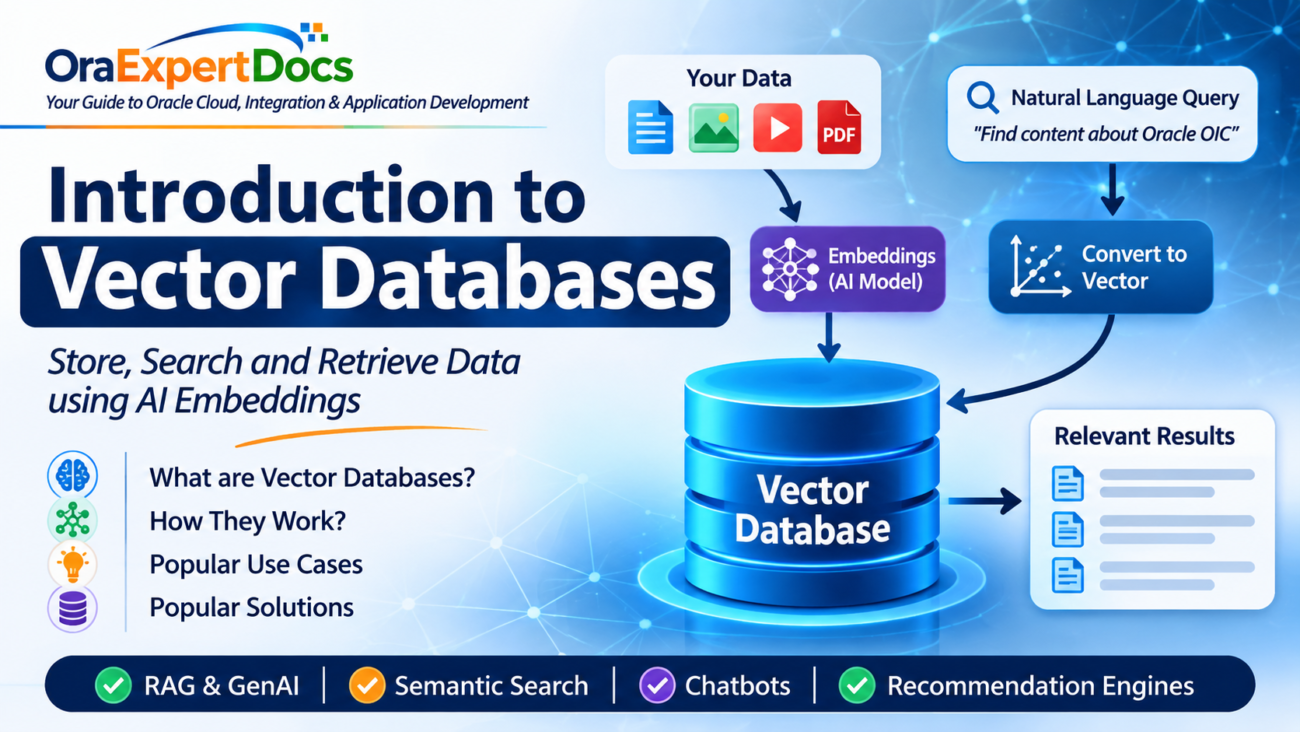
Vector Database- Oracle Database 26 AI
A Vector Database is a specialized database designed to store, index and search vector embeddings efficiently.
It is widely used in Artificial Intellegence (AI), Machine Learning (ML), Natural Language Processing (NLP), Recommendition systems and Retrieval Augemented Generation (RAG) applications.
Let us Understand it step by step:
- What is Vector?
A vector is simply a list of numbers representing the meaning or characteristic of an object.
For example:
Dog ——> [0.24, 0.89, -0.56, 1.23, 0.11]
Instead of storing only the word “Dog” , AI models converts it into numberical values (called Embeddings) that capture its semantic meaning.
Similarly
Cat ——> [0.21, 0.85, -0.60, 1.19, 0.09]
Since Cat and Dog have similar meanings, their vector are close to each other.
2. Why we need Vector Database?
Traditional Database search by exact values.
Consider a movie streaming platform with thousands of movies. In a traditional database, you can easily find movies with the genre “Sci-Fi” or movies released in 2025. However, if a user searches for “movies like Interstellar with space exploration and emotional storytelling”, a traditional database struggles because it requires understanding the meaning of the request. A vector database converts movie descriptions into vectors and finds movies that are semantically similar, such as The Martian, Arrival, or Ad Astra, even if the exact words from the search query do not appear in their descriptions.
3. Difference Between Traditional Database and Vector Database:
Feature | Traditional Database | Vector Database |
|---|---|---|
Primary purpose | Stores and retrieves structured data | Stores and searches high-dimensional vector data |
Search type | Exact-value / rule-based search | Similarity / semantic search |
How data is searched | Matches values, keywords, conditions, etc. | Compares vectors using mathematical similarity |
Example query | Find products where price = ₹100 | Find products similar to this product |
Text search | Mostly keyword-based | Meaning/semantic-based |
Example | Search “running shoes” → finds records containing those words | Search “comfortable footwear for jogging” → can find running shoes, even if those exact words aren’t present |
Image search | Not naturally designed for image similarity | Can find images visually similar to a given image |
AI / ML applications | Requires additional technologies | Designed for AI/ML use cases |
Typical use cases | Banking, ERP, HR, sales, inventory, transactions | RAG, AI chatbots, recommendations, semantic search, image similarity |
Data representation | Rows, columns, tables | Vectors/embeddings, often with metadata |
Matching concept | “Is this value equal to or does it satisfy this condition?” | “How similar is this data to my query?” |
Example technology | Oracle Database, MySQL, PostgreSQL | Oracle AI Vector Search, Pinecone, Milvus, Weaviate |
Best suited for | Transactional and structured data | Unstructured data and AI-powered similarity search |
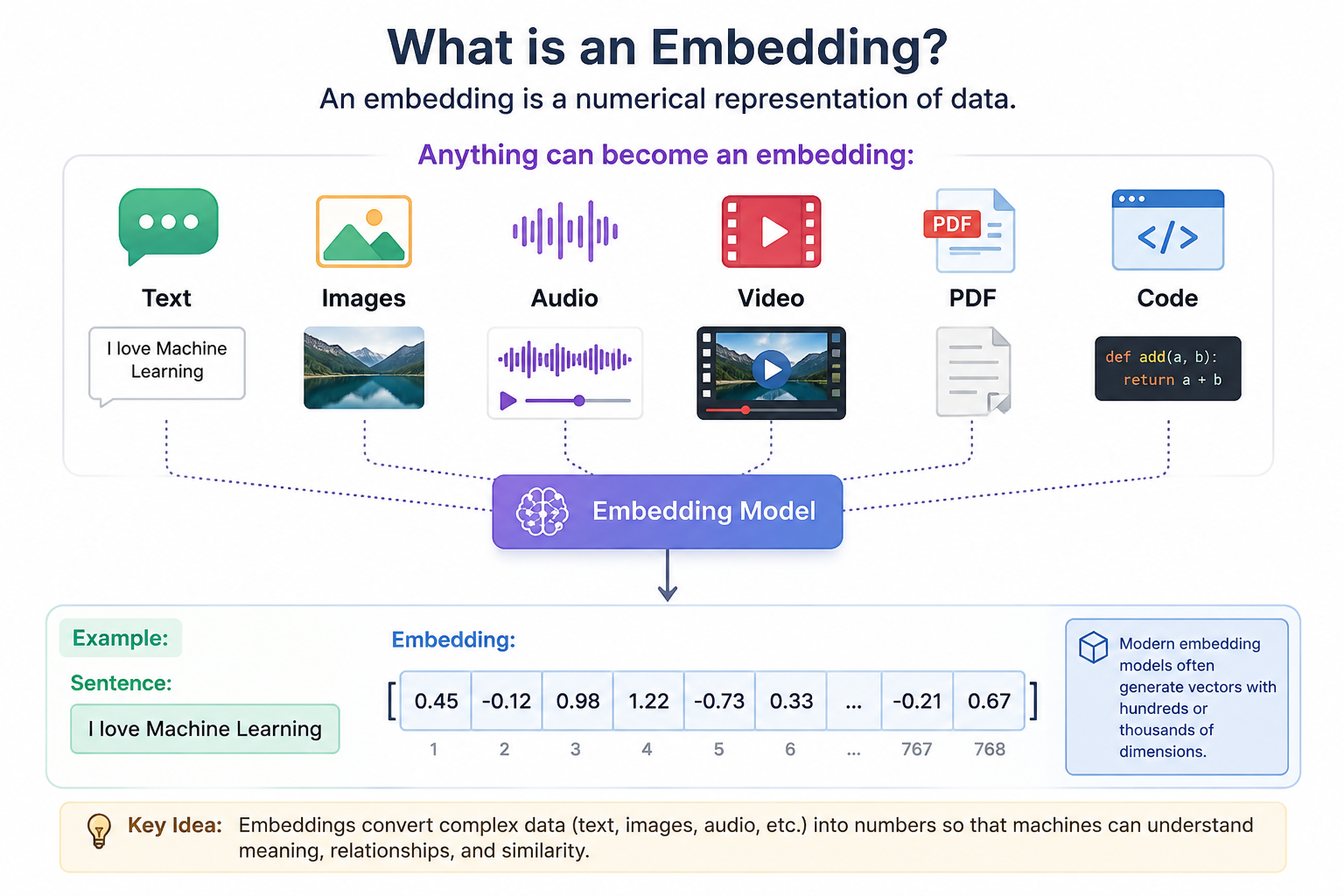
4.What is Embedding?
An Embedding is a numerical representation of data.
Anything can become embedding :
- Text
- Images
- Audio
- Video
- PDF
- Code
5. How Vector Database works?
A vector is a database designed to store and search embeddings (vectors) instead of plain text or number.
Let us understand vector database with example:
Imagine an e-commerce website such as Amazon has millions of Products. A customer searches:
“ I need comfortable shoes for running”.
In this case, customer may not know the exact product name or keywords. They are searching based on meaning and intent.
A vector Database can understand this type of search using embeddings and similarity search.
Let us understand how vector database solve this problem using below architecture:
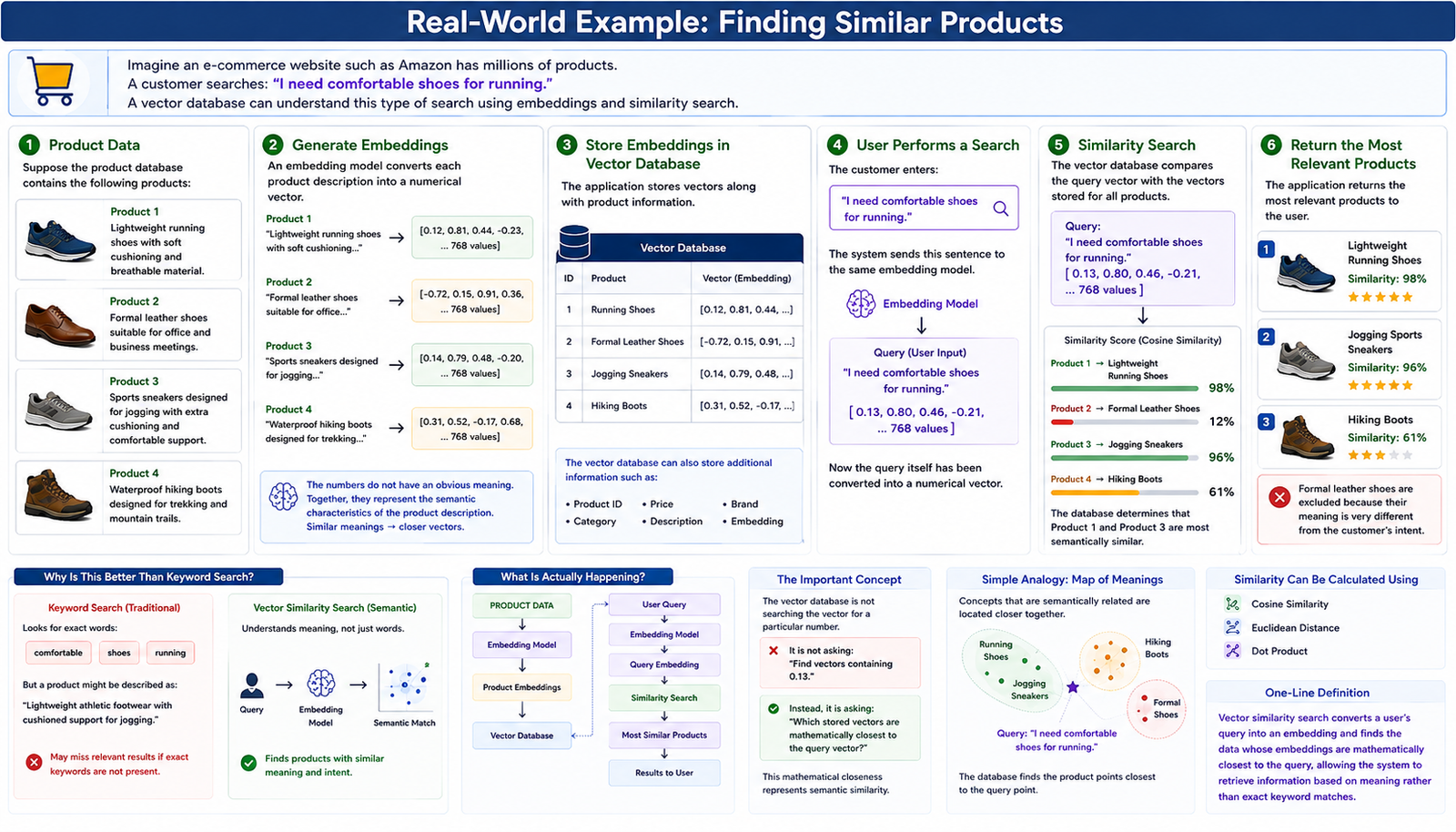
In above example, similarity can be calculated using vector distance.
Below Vector Distance Types are supported:
Vector Distance Type | Description |
Cosine | It basically measures angles between vectors. This is most commonly used for text embeddings. |
Euclidean distance | It measures straight line distance |
Dot Product | Often used in recommendation systems and neural networks |
Manhattan | Instead of calculating a straight-line distance, Manhattan distance adds the absolute differences |
Hamming | Hamming distance is particularly useful for binary vectors |
Jaccard | Jaccard is useful when vectors represent sets or binary features. |
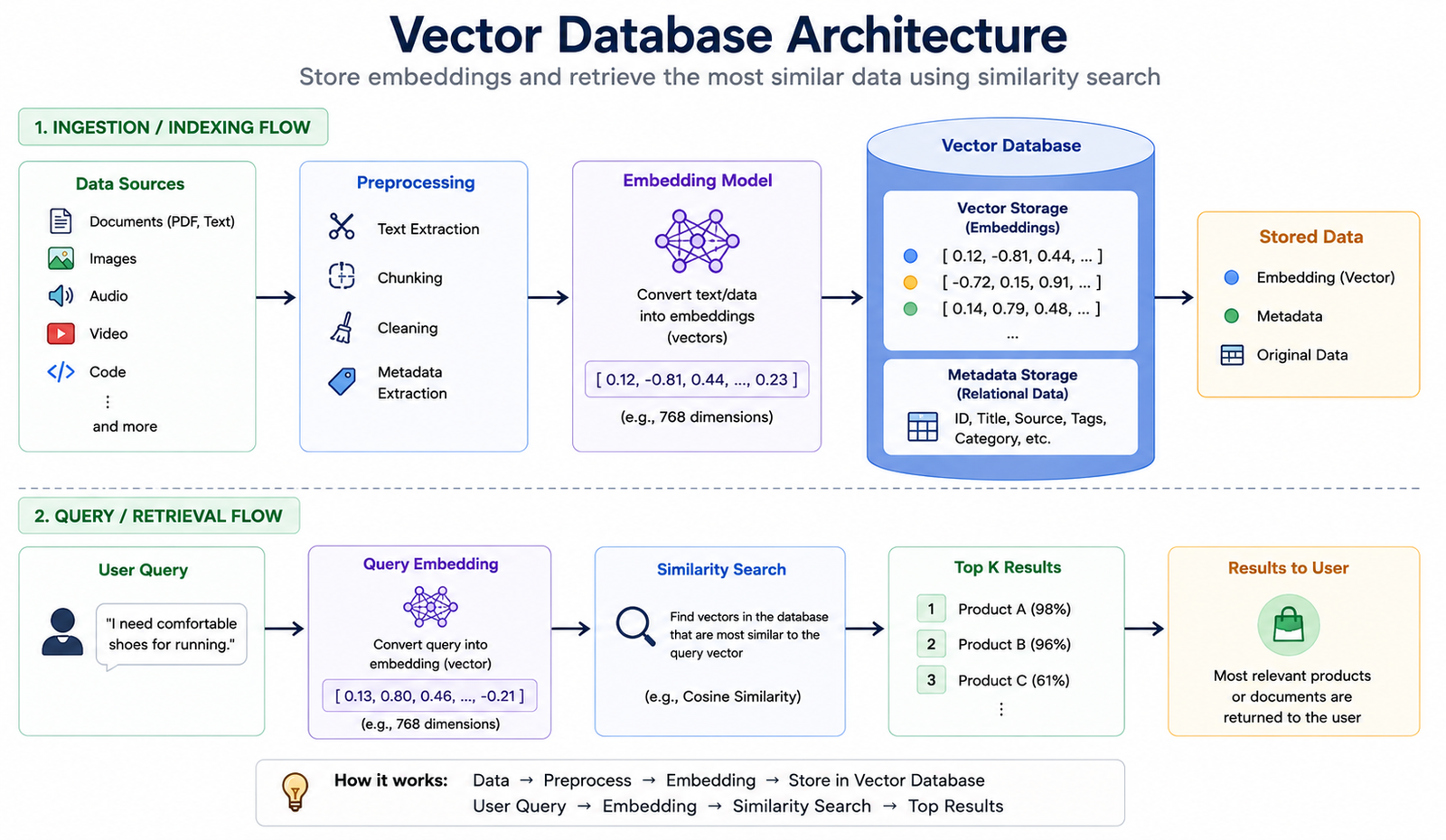
6. Vector Database Architecture:
Below image show complete architecture for vector Database.
7. Vector Indexes:
Comparing a query with every vector becomes slow when there are millions of vectors.
To speed this up, vector database uses specialized indexes.
Vector index is specialized data structure that stores vector embeddings and enable fast similarity search.
When we use Vector Indexes:
- The Index organizes vector so it can quickly find the nearest ones.
- It avoids checking every vector.
- Searches often take milliseconds, even with millions of vectors.
Vector Indexes creates special structure representing relationships between vectors.
